What Is a Fictitious Business Name and Do You Need One?
By
18 Min Read

Your business name is legally fictitious the moment it differs from your legal name. Here is what that actually means, when it triggers a filing, and what registration does and does not protect you from.
A fictitious business name is any name used to conduct business that differs from the legal name of the person or entity operating it. The only real variation is what states choose to call it, and clearing up that terminology confusion is the fastest way to make the rest of this process feel manageable.
As of April 2025, this covers any operating name that doesn't match the owner's or registered entity's legal name, regardless of how minor the difference appears. The clearest way to see this: a sole proprietor named Jane Smith who opens a bakery called "Sunrise Sweets" is operating under a fictitious business name. "Sunrise Sweets" contains neither "Jane" nor "Smith," so the public has no way to know who actually owns the business.

That transparency gap is precisely what the fictitious name system exists to close. It is a disclosure label. It does not create a new business entity or grant trademark protection; it simply creates a public record linking a brand name to its real owner.
The terminology is where most filers lose the thread. As Harbor Compliance (March 2023) explains, the terms "assumed name," "fictitious name," "trade name," and "doing business as (DBA)" are regional equivalents referring to the same concept. The label does not change your obligations.
The legal consequences are concrete. In some states, operating under an unregistered fictitious business name can strip a business of its ability to enforce contracts in court, expose the owner to fines, or force a name change mid-operation. What catches most filers off guard is that registration often triggers a second requirement: public notice of the fictitious name statement.
That publication step is not optional, and filing in the wrong newspaper can void the entire registration. Tools like Column's notice workflow can handle this publication step without requiring you to guess which rules apply in your county.
Key takeaways
A fictitious business name is any name used to conduct business that differs from the legal name of the owner or entity behind it, the definition is consistent across every U.S. jurisdiction, even when the filing rules aren't.
For sole proprietors, the bright line is the surname: drop your last name from the business name and you've triggered a legal filing obligation in most states, whether you know it or not.
Registering a DBA is a disclosure, not a formation, it does not create a new legal entity, shield personal assets, or grant any of the protections that an LLC or corporation provides.
The filing goes to a county clerk or county recorder in most states, not a state agency, and the county where the business operates controls which newspaper qualifies for the required public notice.
Publication requirements are sequential and unforgiving: file with the county, publish in a qualifying adjudicated newspaper for the required consecutive weeks, then file the affidavit back with the county clerk before the statutory deadline. Miss any step and the clock resets.
The obligation catches more businesses than owners expect, an LLC that drops its 'LLC' suffix on a storefront sign or contract can trigger the same fictitious name requirement as a sole proprietor.
Column's Self-Serve Portal lets any filer place a fictitious business name notice in any qualifying U.S. newspaper, choose the paper, build the notice, schedule it, pay, and receive the affidavit, with no account required.
When Your Business Name Becomes Legally Fictitious
Most business owners assume a fictitious business name is something exotic, a made-up brand with no connection to a real person or entity. In practice, the definition is far broader and catches many operators by surprise.

For Sole Proprietors the Surname Is the Bright Line
The test begins with something as simple as a name. For sole proprietors, the rule is straightforward: any business name that omits the owner's legal surname is fictitious by default.
For LLCs and Corporations Even Minor Brand Variations Cross the Threshold
The threshold is even lower, and more surprising, for formed entities. According to industry analysis, any name other than the exact legal name on file with the Secretary of State is considered fictitious for an LLC or corporation, including minor variations like dropping "LLC" or substituting an ampersand for "and." That means a business operating informally under a shortened version of its registered name may already be out of compliance.
Who Actually Has to File
The obligation extends across nearly every business structure. FindLaw's April 2025 guide states that sole proprietors, general partnerships, LLCs, and corporations may all be required to file depending on the state and how they operate. Many owners discover this requirement only after they have already been operating under an alternate name. At that point, they also learn that a newspaper publication requirement follows the filing, and that the clock on that requirement has already started.
Column's Self-Serve Portal exists precisely for that moment of obligation. When a newly-required filer needs to place a legally required public notice in a qualifying newspaper, they can initiate and complete the submission independently online, with no phone calls and no waiting on a newspaper's intake queue. For filers who need documented proof that publication occurred, Column's Automated Affidavits feature delivers systematic, timely proof-of-publication documentation in the format courts and county clerks accept for compliance records.
Why Registering a DBA Does Not Create a New Legal Entity
I'm confused about the legal distinction between the two. A DBA does not create a new legal entity, while a new LLC does. | what we hear from small business owners

No, a DBA Registration Does Not Form a New Business Entity
Registering a DBA creates no new legal entity. A DBA is simply a fictitious name under which a sole proprietor, partnership, LLC, or corporation operates, with the underlying legal entity remaining entirely unchanged. That means a sole proprietor running a photography brand called "Golden Hour Studios" is still personally liable for every contract, debt, and dispute that name generates.
A new LLC creates a legal entity; a DBA registration discloses a name.
One Entity, Multiple Brand Names Under a Single LLC
A single legal entity can register multiple DBAs simultaneously. Citizens Bank confirms that one business entity can register multiple fictitious names to operate different brands without forming separate legal entities for each, a practical and cost-effective way to expand a brand portfolio under one legal structure.
What Registration Actually Unlocks, Bank Accounts, Contracts, and Proof of Name
Beyond branding, DBA registration unlocks essential business functions. Column's platform helps newspapers manage legal and public notice publication efficiently, including the intake, order management, and automated affidavit generation that filers need as documented proof of publication. For business owners placing a required notice, Column's self-serve notice intake lets them initiate and complete the submission independently online.
And once a notice has run, Column's automated affidavits provide the documented proof of publication that compliance records and, in some cases, court filings require, eliminating the bottleneck that has historically made this final step the most error-prone part of an otherwise straightforward registration.
Why Businesses Register a Fictitious Business Name
A significant share of sole proprietors and independent contractors in the United States operate under a trade name rather than their legal name. For most of them, that filing decision is rarely optional, and the reasons extend well past the bank account access that draws most filers to the county clerk's office in the first place. Registration unlocks five concrete operational gates that stay closed without it.
1. Consumer Protection and Public Transparency
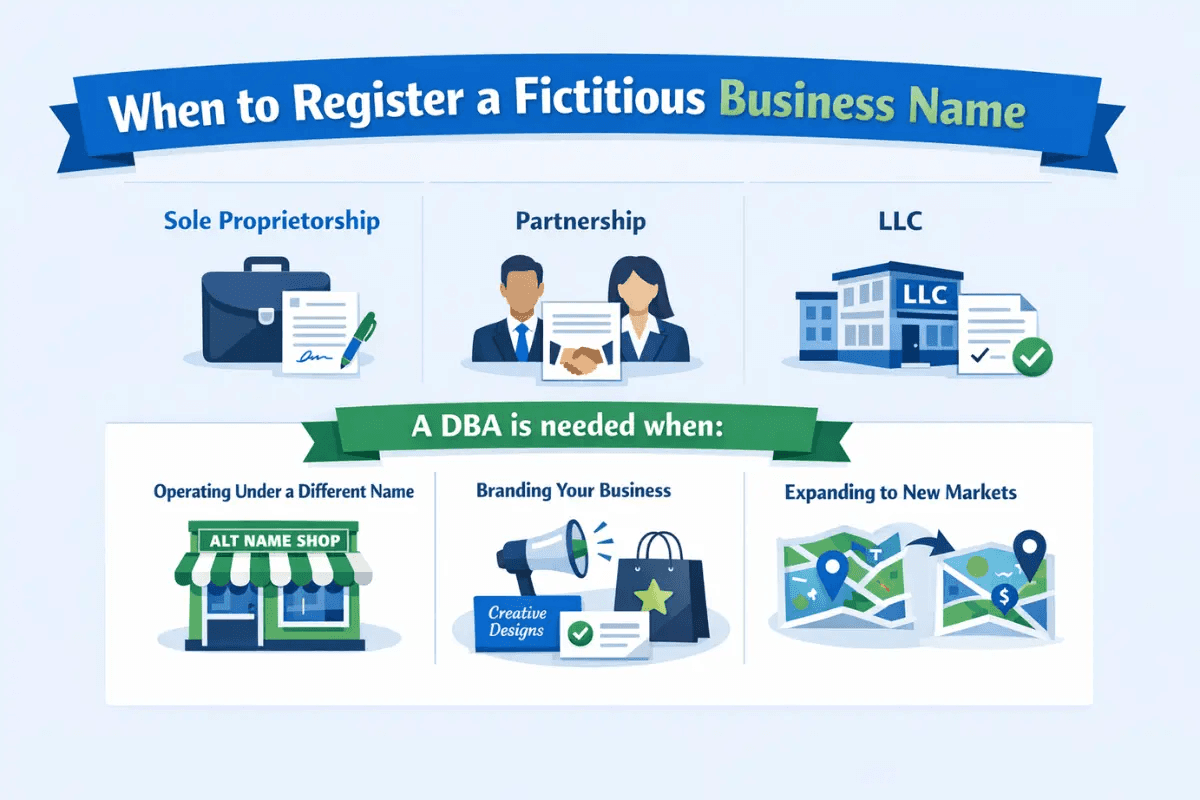
Businesses register a fictitious business name primarily to create a public record linking a trade name to its actual legal owner. That record is the mechanism consumers, creditors, and courts use to identify who stands behind a brand. Without it, a customer harmed by "Park Creative" has no reliable way to find Tom Park. Registration makes the ownership chain visible and verifiable, which is why most states treat it as a legal requirement rather than a courtesy.
One underappreciated wrinkle: business owners who relocate face real identity disruption when a trade name no longer reflects where they actually operate. A brand built around a specific geography, say, one that references a former city or region, can signal the wrong market to new local customers, creating confusion that costs credibility before a relationship even starts. Updating a registered DBA to reflect a new location keeps the public record accurate.
2. Professional Branding for Sole Proprietors and Contractors
Using a trade name instead of a personal name signals credibility to clients before a single invoice is sent. A freelance graphic designer billing as "Park Creative" rather than "Tom Park" presents a professional brand identity that clients associate with a real business operation. The practical upside is immediate: invoices, contracts, and advertising all carry a consistent brand name.
Business owners entering this process also encounter a subtler confusion: whether a name already in use on television, in film, or in other media carries any legal protection when applied to a real-world business. It does not, by default. A name popularized in entertainment is not automatically shielded from commercial registration by others, and building a brand identity around it without independent legal review creates real exposure. DBA registration does not protect that name from use by others the way a federal trademark would, and fictional or media-adjacent names carry additional uncertainty that warrants counsel before the filing is made.
3. Operational Necessity - Banking, Contracts, and Advertising
This is where skipping registration causes the most immediate, concrete damage. Operating under an unregistered DBA can legally block a business from opening a bank account, signing enforceable contracts, or advertising under that name, consequences that state statutes and county clerk guidance consistently describe as the practical result of skipping registration. Banks require proof of fictitious business name registration before they will open a checking account under a trade name. No registration means no business banking, which means no payment processing, no payroll, and no clean separation between personal and business finances. Most filers hit this wall first.
A related threat compounds the problem at the outset: business owners who are new to the FBN process are frequently targeted by scam mailers designed to look like official government renewal notices. These mailers exploit the unfamiliarity that comes with registering for the first time. The filer does not yet know what an official notice looks like, what it costs, or which agency actually sends it. Paying a fraudulent invoice does not fulfill any legal obligation and can leave a filer believing their registration is complete when it is not. Knowing in advance that this targeting is common, and that official fees and timelines are verifiable through the actual county clerk, is the first line of defense against it.
4. Registration Expiration and Mandatory Renewal Cycles

A fictitious business name registration is not permanent. Most states require renewal on a periodic cycle, with the specific timeline varying by jurisdiction. Missing a renewal deadline can lapse the registration entirely, which circles back to the banking and contract problems above. The administrative burden compounds for businesses running multiple brands, since each DBA carries its own renewal calendar.
For businesses managing multiple DBAs across multiple renewal cycles, systematic and timely proof-of-publication documentation is the difference between a clean compliance record and an administrative gap that surfaces at the worst possible moment. Visibility into where every notice stands, from filing through publication and affidavit retrieval, is what keeps that record intact.
5. Expanded Business Flexibility - Running Multiple Brands Under One Entity

A single LLC or corporation can register multiple DBAs to operate distinct product lines or audience-facing brands without forming separate legal entities. A consulting firm might run a training brand and a software brand under one registered company, keeping accounting and liability consolidated while presenting two distinct identities to the market. The tradeoff is administrative: each DBA requires its own registration, its own renewal cycle, and in many jurisdictions, its own public notice publication before the filing is complete.
Managing that publication requirement across multiple brands is where the process most often breaks down. Column's self-serve notice intake and digital public notice search site give filers the ability to initiate submissions independently, track publication status in real time, and retrieve proof-of-publication documentation, all without chasing a newspaper's back office. For filers handling a high volume of notices who need systematic, timely documentation, that infrastructure is the operational difference between a compliance program that scales and one that relies on memory and follow-up emails.
A DBA registration is the entry point into a multi-step compliance chain that includes newspaper publication, affidavit retrieval, and periodic renewal. Registration is only the first gate. In many states, the county clerk will not finalize a fictitious business name filing until one more step is completed, a step most guides bury in fine print, and missing it can unwind everything already set up. That hidden requirement is where the next section begins.
Where Fictitious Business Names Are Filed and What Triggers Publication
Fictitious business names are filed either at the state level or with a local county office, depending on the jurisdiction. Requirements for registration, publication, and proof of compliance vary accordingly.

The Publication Requirement - The Mandatory Step Filing Instructions Bury
In a significant number of U.S. jurisdictions, the law requires a separate newspaper publication step before the fictitious name registration becomes legally valid. Under Florida's fictitious name statute (s.865.09, F.S.), the applicant must advertise the fictitious name at least once in a newspaper of general circulation in the county where the principal place of business is located, and the filer certifies this as part of the signature block at filing. California's requirement, under Business and Professions Code 17900, goes further: publication must run once a week for four consecutive weeks in a qualified newspaper in the relevant county.
Column's Digital Public Notice Search Site gives notices an online, searchable presence, particularly valuable where new legislative or regulatory requirements mandate digital publication or where notices have historically not been searchable after the fact. Combined with Column's Automated Affidavits feature, most beneficial when filers handle a high volume of notices and need systematic, timely proof-of-publication documentation, filers can manage documentation and proof of publication for compliance records without chasing individual newspapers for paperwork.
What Happens If You Skip Publication and How Long the Registration Lasts
Half the challenge is understanding that publication is required at all. The other half is knowing which newspaper qualifies in your specific county, how to submit the notice correctly, and how to obtain the proof-of-publication affidavit your county clerk will demand. Column's Self-Serve Notice Intake lets a filer, whether an attorney, government agency, or business owner, initiate and complete a public notice submission independently online, reducing friction at the point of placement.
Related Reading
How To Register A Fictitious Business Name In Pa
Fictitious Business Name Statement Example
How Much Is A Fictitious Business Name In Florida
How To File A Fictitious Business Name In California
Do I Need A Fictitious Business Name In Florida
How To Register A Fictitious Business Name In Florida
How to Complete Fictitious Business Name Publication Without Getting It Wrong
California requires a minimum consecutive-week publication run for a fictitious business name notice, and the clock does not start until your notice appears in the right newspaper for the right county. Get the newspaper wrong, and those four weeks count for nothing.

The Five-Step Publication Sequence Every Filer Must Complete in Order
The process has a fixed order, and skipping or rearranging any step restarts the timeline. Each step depends on the one before it, so understanding the full sequence before you begin is essential.
Why Any Local Newspaper Is the Most Expensive Assumption in This Process
The legal standard is precise: the newspaper must be a newspaper of general circulation that has been adjudicated for your specific county. According to the Los Angeles County Registrar-Recorder/County Clerk, only an adjudicated newspaper satisfies the legal requirement, and choosing the wrong one invalidates the publication step entirely. The newspaper selection decision is a legal compliance decision. The cost of guessing wrong is a second publication fee plus a delayed bank account opening or contract signing under the fictitious name.
What the Affidavit of Publication Is and Why the County Needs It Back
Once the publication run is complete, the newspaper issues an affidavit of publication confirming that the notice ran for the required number of weeks. Per the Los Angeles County Registrar-Recorder/County Clerk's 2024 guidance, this document must be filed with the county clerk to complete the fictitious business name registration. Timing varies by newspaper. Some papers issue the affidavit within days of the final publication date. Others take several weeks, so building that window into your overall timeline avoids surprises.
How Column's Self-Serve Portal Removes the Qualification Guesswork
Column's public notice platform addresses the adjudication problem directly: filers select their county, see only qualifying newspapers, submit their notice text, schedule the run, pay online, and receive a digitally generated, notarized affidavit without creating an account or making a single phone call. Turnaround times and pricing vary by county and newspaper. For most counties, the qualification filtering alone eliminates the single biggest risk in this process.
Do You Actually Need a Fictitious Business Name
The legal trigger for a fictitious business name filing is far more sensitive than most owners realize. A general contractor named Luis Mendoza operating as "Apex Builds" with no LLC on file is a sole proprietor using a fictitious name and is legally required to register it in most states. The same obligation applies to an LLC that drops its "LLC" suffix on a website, a storefront sign, or a contract. Minor operational variations from the exact registered legal name create a fictitious name by default, which means a significant share of businesses are almost certainly operating under unregistered DBAs without knowing it.

The Three-Question Test That Tells You Whether You Must File
Three questions settle the fictitious name legal requirement for any entity type. First: does the name you use in commerce match your legal name or registered entity name exactly, character for character? Second: are you a sole proprietor using any name that omits your legal surname? Third: does your LLC, corporation, or partnership operate under any shortened, stylized, or alternate version of its state-filed name? The test is about whether any deviation exists at all.
What Happens If You Skip Registration
Under cases such as Klein, a business using an unregistered fictitious name may be barred from enforcing contracts in court, so you cannot sue to collect money owed under agreements made under that name. Beyond lost standing, agents of a business that is careless with fictitious name use can face personal liability in disputes, piercing the corporate shield that normally protects owners from business debts. The protection an LLC provides evaporates the moment the name on the contract does not match the name on file.
From Decision to Done
Once the decision to file is made, most states require a publication step as part of completing registration. That publication step is where the process stalls, because identifying a qualifying newspaper and securing a court-ready affidavit involves systems that were never built to explain themselves to first-time filers.
Column's Self-Serve Portal addresses exactly that friction: place a notice in any newspaper in the United States. Choose the paper, enter customer details, build the notice, schedule it, pay, and receive the affidavit. No account creation required, because the portal's county-level adjudication filter does that verification automatically, removing the step that causes most first-time filers to restart the four-week publication clock.
Related Reading
Difference Between Fictitious Business Name And Dba
Delaware Llc Publication Requirement
New Jersey Llc Publication Requirement
Do You Need A Fictitious Business Name For Llc
Pennsylvania Llc Publication Requirement
Next steps
If your DBA filing feels finished the moment the county clerk cashes your check, the path forward starts with recognizing that the receipt is not the registration. The form is the entry point, and the newspaper publication step that follows is the legal prerequisite that makes the filing valid. Start with our public notice.
The publication requirement is a jurisdictionally enforced legal condition, not a formality, meaning a business that skips it may be operating under an invalid DBA even after receiving a county receipt. The newspaper selection that fulfills that requirement is itself a legal compliance decision, meaning choosing a paper that has not been adjudicated for your specific county voids the entire publication run and restarts the four-week clock at full cost. Together, they point to one concrete action: using a platform that filters for qualifying newspapers before you submit, so the affidavit you receive is one the county clerk will actually accept.
Start with Column's public notice portal to select your county, confirm adjudicated newspapers, submit your notice, and receive a notarized affidavit after publication completes. No account required, and no phone calls to a newspaper's circulation desk to ask a question they may not be able to answer confidently.
Frequently Asked Questions
What's the difference between a fictitious business name and a DBA?
There is no difference, they are regional terms for the same concept. "Fictitious business name," "assumed name," and "doing business as (DBA)" are all labels states use to describe any name used to conduct business that differs from the legal name of the owner or entity behind it. The label your state uses does not change your obligations.
Do I have to register a fictitious business name as a sole proprietor if I'm using my first name in the business name?
Yes, if your legal surname is missing. For sole proprietors, any business name that omits the owner's legal surname is fictitious by default, so "Maria's Bakery" or "Jake's Landscaping" both trigger a DBA filing requirement even though they include a real person's first name.
What actually happens if I operate under an unregistered fictitious business name?
The consequences are concrete: in most U.S. states, operating under an unregistered fictitious name can strip a business of its ability to enforce contracts in court, expose the owner to fines, or force a name change mid-operation. Practically, banks can also refuse to open a business account under a trade name without proof of registration.
Does registering a fictitious business name protect the name from being used by someone else?
No. A DBA registration does not provide trademark protection or exclusive name rights, two businesses in the same county can legally register identical fictitious names. Registration creates a public record linking a trade name to its real owner, but it does not reserve or protect that name the way a federal trademark would.
Is there a publication requirement after I file a fictitious business name?
In many states, yes, filing a fictitious business name registration triggers a mandatory newspaper publication requirement with a filing deadline, and skipping or mishandling that step can void the registration entirely. Filing in the wrong newspaper can also invalidate the registration, so it's important to confirm which newspaper qualifies in your county. Column's self-serve notice intake lets filers initiate and complete that publication step independently online, and its automated affidavits deliver the proof-of-publication documentation that courts and county clerks require.