How to File a Fictitious Business Name the Right Way
By How to File a Fictitious Business Name the Right Way
19 Min Read

Filing a DBA is not one step, it is three. Miss the publication deadline or use the wrong newspaper, and your registration can be voided entirely.
The reality is sharper: a DBA is a legal disclosure mechanism, and operating under one without registering it can expose you to real compliance consequences. With public notice requirements attached to the process in most states, the obligation runs deeper than most guides let on. A fictitious business name, also called a DBA ("doing business as"), is any name a business uses publicly that differs from its owner's legal name or its officially registered entity name. A sole proprietor named Jane Smith who opens "Sunrise Bakery" is operating under a fictitious name. The law requires registration for one reason: public transparency.
See our public notice for how this works in practice. When someone signs a contract with "Sunrise Bakery" or files a dispute, the state needs a public record that traces that brand name back to a specific, legally responsible person. Without that record, the public has no reliable way to identify who is actually behind a business.
Registration is not a technicality. It is the mechanism that makes accountability possible. Sole proprietors are the most obvious group. 3 million firms were sole proprietorships, making them by far the dominant business structure in the country. If your business name differs from your personal legal name in any way, a DBA filing is required.

Partnerships face the same rule when operating under a name other than the partners' combined surnames. An LLC registered under one name that markets itself under a different trade name needs a separate DBA for that trade name. Owners who form an LLC and assume they are fully protected often discover this gap when a bank refuses to open a business account under the trade name, or when a contract dispute surfaces and the operating name has no registered legal anchor.
20.3 million
sole proprietor firms in the U.S.
73.1%
of all U.S. businesses are sole proprietorships
A registered DBA also lets a sole proprietor open a dedicated business bank account, accept payments, and sign contracts under the trade name, all of which require a verifiable legal record. Knowing you need to file is only the starting point. The actual process involves more steps than most guides show, and one of those steps carries a hard legal deadline that can invalidate everything you have already done. That is the step we cover next.
Key takeaways
A fictitious business name is a legal disclosure mechanism, operating under one without registering it creates real compliance exposure, not just a paperwork gap.
The county clerk's office is the midpoint of the process, not the finish line; most states require newspaper publication before your DBA is legally enforceable.
Publication must happen in an adjudicated newspaper, a court-designated status that has nothing to do with circulation size, and that designation is locked to county boundaries, not your preference.
Two hard deadlines start running the moment your FBN is approved, and missing either one can void the entire registration.
Finding a qualifying paper through phone calls and classified desks is an analog obstacle course that was never a design feature, it just was never replaced.
Column's Self-Serve Portal closes that gap: choose any qualifying newspaper in the United States, build your notice, schedule it, pay, and receive your notarized affidavit, no account creation required.
The Step Most Fictitious Business Name Guides Skip Entirely
One layer beneath that misunderstanding sits an even more consequential blind spot: many first-time business owners don't realize a Fictitious Business Name filing is a prerequisite before opening a business bank account, a step that most guides fail to highlight upfront, which means filers are often racing toward a deadline they didn't know existed, for a requirement they only discovered mid-process. State-mandated publication requirements are a frequently overlooked component of DBA filings, and most county clerk websites describe the form-and-fee step but bury or omit the publication requirement entirely, leaving filers to discover it only after the clock has already started.

Missing the Publication Deadline Can Void Your Registration, Not Just Delay It
Missing the deadline doesn't pause your registration. It can erase it.
Missing the deadline doesn't pause your registration. It can erase it.
California Business and Professions Code § 17917 requires registrants to publish within 45 days of filing in a newspaper of general circulation in the county where the statement was filed. As Cummings & Cummings Law explains in its analysis of state publication rules, these statutory timelines are strict: miss that window and filers risk having their registration voided, potentially requiring them to refile and repay all associated fees. Column's Automated Affidavits feature addresses that downstream risk directly: after a legal notice has been published, filers receive documented proof of publication suited for compliance or court records, generated systematically rather than chased down manually.
Not Every Local Newspaper Counts - The Adjudication Trap
Publishing in the wrong newspaper is legally equivalent to not publishing at all. The newspaper used must be an "adjudicated" qualifying paper for the specific county where the business is registered, not just any local paper, and most filers have no guidance on how to verify whether a given newspaper meets this standard. As Cummings & Cummings Law notes in its review of corporate filing publication rules, adjudicated status means a court has formally recognized the paper as a newspaper of general circulation for that jurisdiction, a distinction that is easy to overlook and costly to get wrong.
Column's Self-Serve Portal addresses this directly by routing notices only to newspapers that meet the adjudication requirement for the relevant county. For filers handling a high volume of notices who also need systematic, timely proof-of-publication documentation, Column's Order Management layer and Automated Affidavits work in sequence: the notice goes out through the right channel, and the system automatically generates and manages affidavits of publication after a notice runs, eliminating the manual process of requesting and tracking proof-of-publication documents.
Steps to File a Fictitious Business Name Without Missing a Requirement
Filing a Fictitious Business Name Without Missing a Requirement
Seven steps stand between your business idea and a legally enforceable fictitious business name, and the county clerk's office is only the midpoint of that journey. Each step feeds directly into the next, and the sequence is unforgiving: skipping or misordering any one of them can void the entire registration. Filers who treat the stamped receipt as a finish line are mid-process with two hard deadlines already running, either of which can void the entire registration if missed.
"Filers are caught off guard by the public signature requirement on the fictitious name registration form, which can undermine privacy-focused business structures set up specifically to keep personal names off public records."
— what we hear from small business owners
Step 1 - Search Name Availability Across County, State, and Federal Trademark Databases

Before investing in branding, run your proposed DBA through your county clerk's online database, your state's business registry, and the USPTO's TESS trademark search tool. This three-layer check catches conflicts at every level. The real tradeoff: a name clear at the county level can still infringe a federally registered trademark, exposing you to costly litigation, so skipping any one layer creates meaningful legal risk.
Step 2 - Obtain the Official Fictitious Business Name Statement Form From the County Clerk

Most counties provide the FBN Statement form through their clerk-recorder website, an in-person office visit, or a state business portal. Downloading the form online is fastest, but some counties require original signatures on paper copies, making the in-person or mail route necessary. Confirm your county's accepted format before filling anything out, using an outdated or unofficial form is a common reason applications get rejected.
Step 3 - Complete the FBN Application With All Required Fields Accurately

The application requires the exact fictitious business name, a principal street address (P.O. Boxes are almost universally rejected as the sole address), full legal names and residential addresses of all owners, and the business structure type, sole proprietor, partnership, LLC, or corporation. Errors or omissions on any of these fields will result in rejection or a defective filing, restarting your timeline and potentially your publication deadline.
Step 4 - Submit the Form and Pay Filing Fees at the Correct Local or State Office

FBN filings are handled at the county level in most states, not a state agency, meaning you file with the county clerk or recorder in the county where your principal business address is located. Fees typically range from $10 to $100 depending on jurisdiction and the number of business owners listed. Submission options vary by county: in person, by mail, or online. Filing in the wrong county is a common and costly mistake.
Step 5 - Publish the Required Notice in a Qualifying Adjudicated Local Newspaper
After filing, most states require you to publish a notice of your fictitious business name in an adjudicated newspaper of general circulation in the county, once per week for four consecutive weeks. This must typically be completed within 30 to 45 days of your filing date. Not every local paper qualifies; the county clerk's office usually maintains a list of approved publications. Missing the deadline can void your registration entirely.
Step 6 - Obtain the Affidavit of Publication and File Proof With the County Clerk

Once your four-week publication run is complete, the newspaper will issue a signed affidavit of publication. You must submit this document to the county clerk to finalize your FBN registration. Without this step, your filing is technically incomplete and unenforceable in many jurisdictions. Allow extra time for the newspaper to prepare the affidavit, some publications take one to two weeks after the final run to issue it.
Step 7 - Determine Whether to File at the State or Local Level Based on Your Business Structure
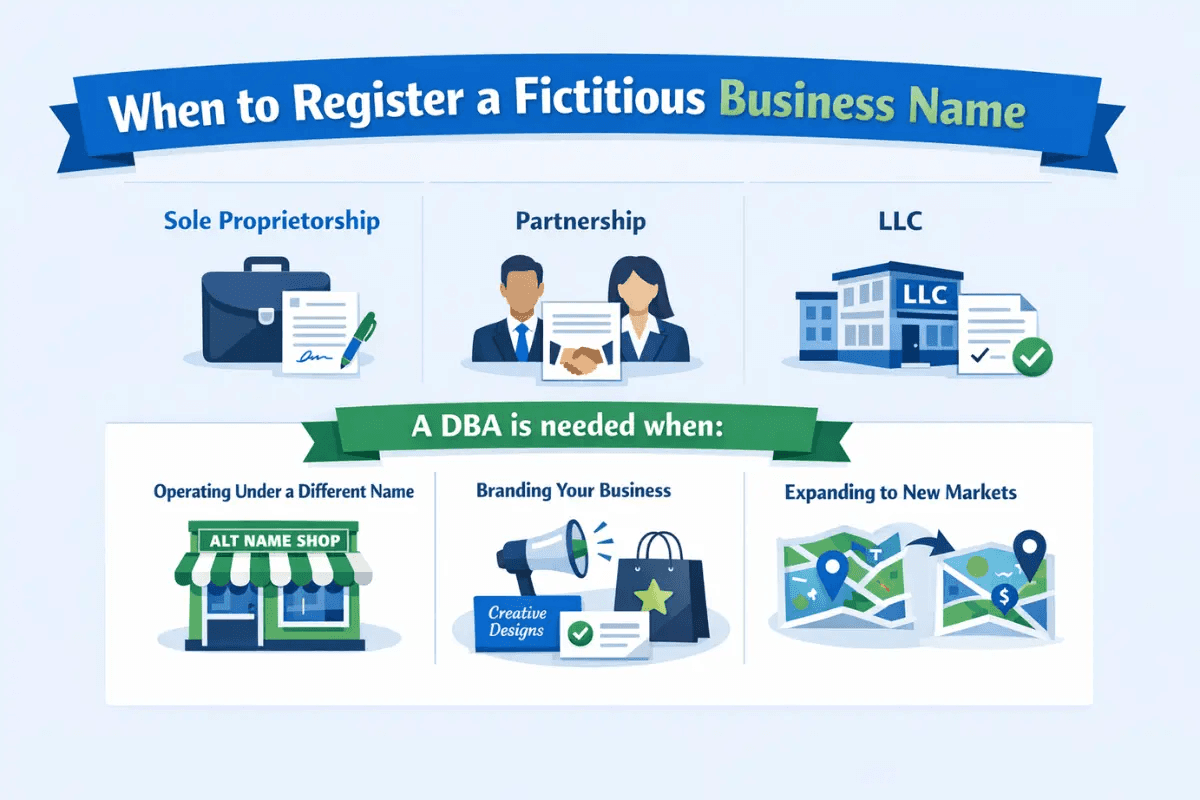
In most U.S. states, fictitious business name filings are a county-level requirement handled by the county clerk or recorder, not a state agency. However, some states centralize DBA registration at the state level, and certain entity types such as LLCs or corporations may have different or additional requirements. Confirming the correct filing authority for your state and business structure before you begin prevents wasted fees and duplicate filings.
Related Reading
How To Register A Fictitious Business Name In Pa
Fictitious Business Name Statement Example
How Much Is A Fictitious Business Name In Florida
How To File A Fictitious Business Name In California
Do I Need A Fictitious Business Name In Florida
How To Register A Fictitious Business Name In Florida
How to Find a Qualifying Newspaper and Get Your Affidavit Without the Runaround

This means that choosing a cheap or nearby newspaper without verifying county-specific adjudication status is the single most likely way to complete the entire DBA publication run, paying for four consecutive weeks of notices, and still have the registration void.
Three Reliable Ways to Verify a Newspaper Qualifies Before You Pay
First, contact your county clerk directly and ask for the list of adjudicated newspapers on file. Column's publisher network is pre-verified for county-level adjudication, so when you place a notice through its self-serve portal, you are selecting from papers that already qualify for your jurisdiction, removing the verification burden entirely.
What Your Notice Text Must Include and What a Single Error Costs You
State publication requirements consistently specify that a qualifying notice must include the fictitious business name, the owner's legal name, the business address, and the filing date, and most state statutes or county clerk instructions list these fields explicitly.
How the Affidavit of Publication Works and What You Must Do With It
The affidavit of publication is a separate legal document, distinct from the newspaper's invoice or proof of insertion, that the filer must actively obtain and then submit to the county clerk to formally close the registration. Column's automated affidavits feature addresses both sides of that problem directly. Partner newspapers in the Column network generate and deliver court-ready, notarized affidavits digitally, so filers can track notice status in real time and receive proof-of-publication documentation without waiting on postal delivery.
What to Do After Your Fictitious Business Name Is Approved
Approval also does not equal protection, and understanding where FBN registration ends and trademark law begins can save you from a costly gap in brand security down the road.

What You Can Do the Day You Receive Your FBN Certificate
Once the certificate is in hand, a business should use the registered trade name when opening a bank account, updating contracts and invoices, and applying for any business licenses or permits that reference the trade name. If you structured your business through a multi-level LLC or holding company specifically to limit public exposure of ownership details, be aware that in Florida the signing page of your FBN filing is publicly viewable on the Florida Department of State, Division of Corporations (Sunbiz) database, so plan your disclosure posture accordingly.
Why Your Renewal Deadline Deserves the Same Urgency as Your Original Filing
The Florida Department of State, Division of Corporations (Sunbiz) sets the fictitious business name validity period at five years, with renewal required by December 31 of the fifth year, and missing that deadline means the registration lapses entirely. If a renewal notice arrives and you are unsure whether it is legitimate, verify renewal requirements and deadlines directly with your county clerk or on the Florida Department of State, Division of Corporations (Sunbiz) website before sending any payment.
The Compliance File You Should Build Now
Harbor Compliance recommends retaining the FBN certificate, copies of the published notices, and the affidavit of publication together, because publication is a legally required step that must be documented alongside the county clerk filing. Column's self-serve portal stores the affidavit digitally and delivers it to the filer's inbox once it is executed, so the compliance record is available from day one. For businesses that place a high volume of legal notices over time, Column's order management tools and automated affidavit workflow create a systematic, searchable record of every published notice and every corresponding proof of publication, so that when renewal documentation is required, the file is already built.
Next steps
If your DBA filing felt complete the moment the county clerk stamped your form, the path forward starts with understanding that the stamp opens a closing window, not a finished door. State law in most jurisdictions requires publication within a hard statutory deadline from that filing date, and missing it can void the registration entirely, regardless of fees already paid. Start with our public notice.
The adjudication trap makes that deadline more consequential, not less. Completing four consecutive weeks of paid notices in a newspaper adjudicated for the wrong county is legally equivalent to never publishing at all, meaning the county filing you already paid for becomes unenforceable. The affidavit of publication is what actually converts a completed notice run into recognized legal compliance, and errors in notice text or paper qualification can force the entire run to restart. Together, those two realities point to one practical conclusion: the publication step requires a verified, county-specific workflow before you schedule a single insertion, not after.
Start with a public notice placed through Column's self-serve portal. Select a pre-verified qualifying newspaper for your filing county, enter your notice text, schedule your run dates, and pay by card in a single session, with no account required. After the final insertion, a digital notarized affidavit is generated automatically and delivered to your inbox, giving you the court-ready proof of publication your county clerk requires to close the registration and your bank will require before opening a business account under the DBA name.
Frequently Asked Questions
What exactly is a fictitious business name?
A fictitious business name is any name a business uses publicly that differs from its owner's legal name or its officially registered entity name. For example, a sole proprietor named Jane Smith who opens "Sunrise Bakery" is operating under a fictitious name and is required to register it so the public has a way to trace that brand name back to a legally responsible person.
If I already formed an LLC, do I still need to file a DBA?
Yes, an LLC registered under one name that markets itself under a different trade name needs a separate DBA for that trade name. Owners who assume their LLC covers all operating names often discover the gap when a bank refuses to open a business account under the trade name or when a contract dispute surfaces and the operating name has no registered legal anchor.
What happens if I miss the publication deadline after filing?
Missing the deadline doesn't pause your registration, it can erase it entirely. In California, for instance, publication must begin within 45 days of filing, and missing that window risks having the registration voided, potentially requiring you to refile and repay all associated fees. The county clerk's office will not send a warning, and there is no grace period notice.
Can I just publish my DBA notice in any local newspaper?
No, publishing in the wrong newspaper is legally equivalent to not publishing at all. The newspaper must hold adjudicated status specifically for the county where your business is registered, meaning a court has formally recognized it as a newspaper of general circulation for that jurisdiction. A sole proprietor who completes four consecutive weeks of paid notices in a paper adjudicated for the wrong county must restart the entire publication cycle from scratch.
Does a DBA need to be filed with the state or with the county?
It depends on your business structure and state. Most sole proprietors and general partnerships file at the county clerk level in the county where the business operates, while LLCs and corporations typically file fictitious names at the state level through the Secretary of State's office, though some states require both a state filing and a county publication. Pennsylvania, for example, has handled fictitious name registrations at the state level through the Department of State since the early 1980s, so you should confirm your state's specific requirements before submitting anything.