Fictitious Business Name Statement Example and How to File It
By Fictitious Business Name Statement Example and How to File It
19 Min Read

Most first-time filers think the county form is the finish line. It isn't. Here is what every field legally commits you to, and what happens if you stop there.
That instinct is understandable. But every field on that document exists for a specific legal reason, and the obligations it triggers extend well beyond the county clerk's office. Understanding what the statement actually contains, and why, is the foundation for getting every subsequent step right. See our public notice for how this works in practice. According to the San Mateo County Assessor-County Clerk-Recorder, a fictitious business name statement is a legal document required when a business operates under a name other than the owner's legal name. Every field on the form maps directly to that purpose.

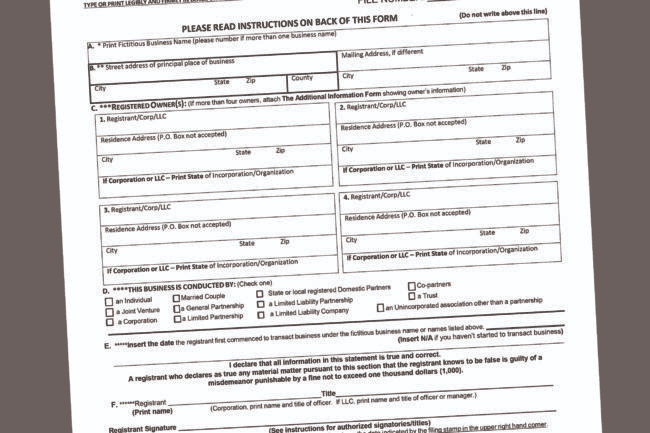
The fictitious business name field captures the trade name the public will encounter. The registrant's legal name ties that trade name to a real, accountable person or entity. The business address establishes jurisdiction and gives creditors or consumers a place to direct correspondence. The entity type field determines which signature and notarization requirements apply. The owner's signature, often notarized, converts the form from a declaration into a sworn legal statement.
The FBN statement is filed with the County Clerk-Recorder and becomes a public record immediately upon acceptance. That is the mechanism that lets consumers, creditors, and courts trace a trade name back to a real owner. A contractor who hires "Sunrise Bookkeeping" and is never paid can search the county's public index, find the owner's legal name and address, and pursue a claim. This is why California Business and Professions Code Section 17900 mandates the registration in the first place. These two terms describe different things. The FBN statement is the document you submit to the county. The DBA certificate is what the county returns after accepting that statement.
Banks routinely ask for the DBA certificate when you open a business account under a trade name; arriving without the file-stamped copy will stall the process. Understanding what the document contains is only half the equation. The other half is knowing whether you are legally required to file one, an answer that depends on your business structure and state, with triggers that are often less obvious than most new owners expect.
Key takeaways
A fictitious business name statement is a county-level filing, not a statewide one, which means a name registered in Los Angeles County can be legally registered again in San Diego County by someone else.
The county clerk's stamp does not complete your registration. It starts a mandatory publication clock, and missing that window voids the filing entirely, with no warning letter first.
Banks reject business accounts over missing FBN statements more often than most new owners expect, and the publication affidavit is frequently the document they're waiting on.
Three separate bills come with every FBN registration: the county filing fee, the newspaper publication cost, and (in some counties) a certified copy fee. Budgeting for only one is the most common reason filers stall mid-process.
The newspaper you choose for publication must be adjudicated for the specific county where you filed. A credible, widely read paper in the wrong county makes the notice legally worthless.
California's five-year expiration clock starts on the filing date, not on the date you open for business or remember to check.
Column's Self-Serve Portal lets you place your FBN publication notice in any qualifying newspaper in the United States, choose the paper, build the notice, schedule it, pay, and receive the affidavit, with no account creation required.
Who Must File an FBN Registration Statement and When
Banks reject business accounts more often than most new owners expect, and the reason is almost always the same: no FBN statement on file. According to industry data, a DBA filing is required when any sole proprietor, partnership, LLC, or corporation operates under a name that differs from its legally registered name, and the obligation is broader than most owners initially assume.

Which Business Structures Are Actually Required to File
The surprise for most owners is that LLCs and corporations are not exempt. As Wolters Kluwer BizFilings explains, an LLC formation does not automatically cover trade names or brand names; a separate fictitious business name registration is required for each name used in commerce that differs from the LLC's legal name. An LLC named "Apex Holdings LLC" that runs a restaurant under "The Corner Grill" must file.
The filing requirement is triggered by the name you use, not the structure you chose. There is a second consequence of filing that home-based sole proprietors routinely discover too late: the moment your FBN statement is accepted by the county clerk, your personal home address, name, and phone number become part of a publicly searchable record, a privacy exposure worth planning for before submission.
The Hidden Trigger Events That Force an FBN Filing
The obligation activates whenever a business operates under any trade name or brand name that does not match its official legal name, regardless of how long the business has been running. Most states impose a filing deadline within a short window after commencing business under the trade name, so the clock is already running by the time the bank asks.
Why County and State Jurisdiction Determines Your Obligation
There is no single national FBN rule. Wolters Kluwer BizFilings is direct on this point: requirements including who must file, filing fees, renewal periods, and publication obligations vary by county and state, and the rules that apply to your business depend entirely on where it operates.
How to Check Fictitious Business Name Availability Before You File
The problem is that most prospective filers search in the wrong place, treating a statewide entity database as a proxy for county-level FBN availability when the two systems govern entirely different things. For teams managing multiple filings across counties, knowing exactly where to search and what each result actually tells you is the difference between a clean filing workflow and a cascade of missed deadlines.

Why a Statewide Name Search Won't Protect You at the County Clerk's Window
According to the Los Angeles County Registrar-Recorder/County Clerk, FBN registrations are county-level in California, with no statewide exclusive name reservation system in place. That means a fictitious business name can be legally registered in Los Angeles County while remaining completely open in San Diego County, and vice versa. Searching only at the state level gives you no reliable signal about county-level availability. Many prospective business owners skip the pre-filing availability search entirely and only discover a name conflict after the county clerk rejects their form or a bank flags the name during the business account opening process.
Where to Actually Run the Search
Both are free to use before you commit. Search by the exact name you intend to register, then run variations with common misspellings or abbreviations.
Active vs. Expired Registrations and What to Do If Your Name Is Taken
Not every result blocks you. Check whether the registration is still within its five-year term and whether it has been renewed. If the registration is genuinely active, your options are limited but clear: modify the name enough to distinguish it, or choose a different name entirely. Once you have a clear name, publication must follow. Column coordinates directly with newspapers and manages the process end to end across all publications. Once a notice is published, Column's automated affidavit system delivers documented proof of publication directly, which is most useful when volume is high and timely proof-of-publication documentation is non-negotiable.
How to File a Fictitious Business Name Statement Step by Step
The county clerk's stamp on your fictitious business name statement is not confirmation that your registration is complete. It is the starting gun for a mandatory publication clock that most first-time filers never see coming. The county clerk's stamp on your fictitious business name statement is not confirmation that your registration is complete. It is the starting gun for a mandatory publication clock that most first-time filers never see coming.
Step 1 - Obtain the Correct County FBN Form Before You Do Anything Else

Every California county uses its own version of the fictitious business name statement form, and using the wrong county's PDF is a leading cause of rejection. Visit your county clerk-recorder's office in person or download the current form directly from the county website. Alameda, Los Angeles, and Orange counties all maintain distinct forms, so confirm you have the right jurisdiction's document before filling in a single field.
Step 2 - Complete All Required Fields - Legal Name, Address, Entity Type, and Notarization

A fictitious business name statement example must include the registrant's full legal name exactly as it appears on government ID, the principal business address, the fictitious name being registered, and the entity type (sole proprietor, partnership, LLC, corporation). Some counties require notarization of the owner's signature. Incomplete fields or mismatched legal names are the top rejection triggers, so cross-check every entry against your formation documents before submission.
Step 3 - Submit to the Correct County Office With Payment via Mail, In-Person, or Online Portal

Once your form is complete, submit it to the county clerk-recorder's office that covers your principal business address, not your home county or the county where you incorporated. Orange County accepts in-person and mail submissions but does not currently accept online payments, a common friction point. Los Angeles County offers an online portal. Filing fees typically range from $26 to $100 depending on the number of fictitious names and owners listed.
Step 4 - Receive Your File-Stamped Copy and Note the Filing Date That Starts the Publication Clock

After the county processes your filing, you receive a file-stamped copy bearing the official filing date. In California, this date is critical: it triggers a mandatory 30-day window during which you must publish the statement in a general-circulation newspaper adjudicated for your county. Missing or miscounting this window invalidates the filing. Keep the stamped copy as proof of timely filing and confirm the publication deadline with your county clerk at the time of submission.
5. California-Specific FBN Rules - Publication Mandate, 5-Year Renewal, and How Other States Differ
California's publication mandate is among the more structured in the country. The filing is valid for five years from the date of filing, and if any facts in the statement change before that, the statement expires at the point of change. One practical exception applies: if a renewal is filed close to expiration and the underlying information has not changed, publication is not required for that renewal. Texas and Florida impose no comparable newspaper publication requirement for DBA registrations, which makes California's four-week consecutive publication rule a genuine compliance burden that filers from other states rarely anticipate.
After the county stamps your FBN statement and returns the file-stamped copy, most first-time filers hit an immediate wall: they do not know which newspaper legally qualifies, how to submit notice text, or how to get the affidavit back before a bank or registration deadline. Calling newspapers one by one to find out is exactly the kind of opaque scramble that Column's self-serve public notice portal eliminates, letting filers choose a qualified paper, build the notice, pay, and receive a compliant affidavit without creating an account or making a single phone call.
6. Common Rejection Errors - Wrong County, Mismatched Legal Name, and Missing Owner Signatures

Three errors account for the overwhelming majority of FBN rejections before the form ever reaches a file stamp: submitting to the wrong county office, listing a legal name that does not precisely match the Secretary of State record, and omitting a required owner signature. A common pattern among first-time filers is treating the form as a simple fill-in exercise, only to discover at the counter that the LLC name on the form includes "LLC" while the state record uses a comma before it.
That single character difference is enough for rejection. Getting the form right and the county submission correct are table stakes, but the file-stamped copy in your hand is a starting gun. The next section covers the publication requirement that clock triggers, why the rules around newspaper selection are stricter than most filers expect, and exactly what happens to your registration if you get them wrong.
FBN Filing Step-by-Step Checklist
Use this checklist to track every required action before your registration is complete:

Confirm county jurisdiction, file where your business is principally located, not where you live
Run the county FBN availability search, use your county clerk's online tool before paying any fee
Obtain the correct county form, download from your specific county clerk's website
Complete all required fields, legal name (exact match to Secretary of State record), business address, entity type, owner signature
Submit with payment, note accepted methods (Alameda County: cash, debit, check, or money order; no credit cards in-person)
Record the file-stamp date, this starts your 30-to-45-day publication clock
Identify a qualified (adjudicated) newspaper for your county before the window expires
Place the FBN notice for four consecutive weeks in the same qualified paper
Collect the affidavit of publication from the newspaper upon run completion
File the affidavit with the county clerk within 30 days of the publication run's completion
Calendar your 5-year renewal date from the original filing date
The FBN Newspaper Publication Requirement That Can Void Your Filing

Why the Law Requires a Qualified Newspaper Not Just Any Publication
Adjudication is the legal designation that separates a qualified newspaper from every other publication in your county. Under California Business and Professions Code § 17917, your FBN statement must appear in a newspaper of general circulation, a term with a precise legal meaning: the paper must have been formally court-designated for your specific county.
In Los Angeles County, the county clerk publishes a list of adjudicated newspapers; that list is often shorter than filers expect, and choosing any paper outside it voids the filing entirely, even if the notice ran for the correct number of weeks and in the correct format. Column's digital public notice search site is built for this problem: it is most beneficial when notices are not currently searchable online or when filers need to locate qualified publications fast, without cold-calling county offices.
The Privacy Reality of FBN Publication, and Why Newspaper Choice Matters Even More
There is a disclosure many first-time filers don't anticipate: the FBN statement that runs in the newspaper is a verbatim reproduction of what you filed with the county clerk. Column's digital public notice search site supports that requirement directly: when legislative or regulatory requirements call for notices to be published digitally and made searchable, Column provides the infrastructure newspapers need to comply.
The 30-Day Publication Window and What Happens If You Miss It
California Business and Professions Code requires publication to begin within 45 days of filing your statement. Column is built to remove that delay. Rather than hunting through county lists and waiting for callbacks, filers can use Column's self-serve portal to identify a qualified paper, initiate notice intake independently online, and place the notice without going through a manual back-and-forth. When a customer needs to place a public notice, they initiate and complete the submission independently, which is the kind of speed the 45-day window demands.
Four Consecutive Weeks - What the Publication Run Schedule Actually Means
The statute is specific: your FBN statement must run once a week for four successive weeks in the same qualified newspaper.
The Affidavit of Publication - The Document That Closes the Loop
Under California Business and Professions Code, you must file that affidavit with the county clerk within 30 days of the publication run's completion. Column's automated affidavits feature is designed for this moment. After a legal notice has been published and filers need documented proof of publication for compliance or court records, Column generates the affidavit systematically, most beneficial for operations handling a high volume of notices that require timely, consistent proof-of-publication documentation.
Why a Government Website Cannot Substitute for a Qualified Newspaper
Column's digital public notice search site reinforces this principle: it is most beneficial when newspapers face new legislative or regulatory requirements to publish notices digitally, or when existing notices are not yet searchable online.
Related Reading
How To File A Fictitious Business Name In California
How To Register A Fictitious Business Name In Pa
How Much Is A Fictitious Business Name In Florida
Do I Need A Fictitious Business Name In Florida
How To Register A Fictitious Business Name In Florida
FBN Filing Fees and Publication Costs to Budget Before You Start

The County Clerk Fee Is Just the Opening Charge
According to the Los Angeles County Registrar-Recorder/County Clerk 2025 fee schedule, that fee is $26 for the first registrant, with additional charges for each additional registrant on the same statement. Santa Barbara County matches that same $26 starting rate, per the Santa Barbara County Clerk, Recorder, Assessor & Elections, Fictitious Business Name Fees 2025 published schedule. The only legitimate fee owed to the county clerk is the one listed on the county's own published fee schedule, such as the Los Angeles County Registrar-Recorder/County Clerk schedule linked here.
The Separate Newspaper Bill Most Filers Don't See Coming
Publication in a county-adjudicated newspaper is a legally required step that the county never collects payment for and never arranges on your behalf, as confirmed by the Los Angeles County Registrar-Recorder/County Clerk. Publication costs in California vary by county and newspaper, and are paid separately from the county filing fee.
Column's Automated Placement can remove friction at this step. Filers can submit through Column's Self-Serve Portal, which handles notice intake and routes the publication to a qualifying outlet on their behalf, rather than independently researching which newspapers hold adjudicated status in a given county and negotiating placement terms directly.
Your True Cost-to-Complete Across All Three Layers
Once publication finishes, you must obtain an affidavit of publication from the newspaper and file it with the county clerk, as required under the Los Angeles County Registrar-Recorder/County Clerk process. Some California counties charge a separate fee for accepting that affidavit filing, making it a distinct third cost on top of the first two.
The county fee, paid to the county clerk at the time of filing
The newspaper's publication charge, paid directly to an adjudicated newspaper
Potentially an affidavit filing fee, paid to the county clerk when submitting proof of publication
Column's Automated Affidavits capability is designed to address this directly: after a legal notice has been published, the system produces documented proof of publication that filers can use for compliance or county records, eliminating the manual follow-up step of tracking down the newspaper and requesting a signed affidavit separately.
FBN Statement Expiration and Renewal Before Your Registration Lapses
The clock starts the moment you file, and California Business and Professions Code § 17920 makes no exceptions for businesses that forgot to track the date.

Five years from the filing date. That is the statutory expiration for every fictitious business name statement in California, according to California Business and Professions Code § 17920, and renewal must be completed before that deadline passes.
Renewing a fictitious business name statement in California requires completing the same sequence as the original filing: a new form, a new county fee, a new four-week newspaper publication run in a qualified newspaper of general circulation, and a new affidavit of publication filed with the county clerk. Each of those steps carries its own timeline, so waiting until the expiration date is already close leaves little room for error.
That last step, the affidavit of publication, is a legal matter. Column's automated affidavits are generated after a legal notice has been published and are designed for filers who need documented proof of publication for compliance records or court filings, delivering a clean, timestamped affidavit without requiring follow-up with the newspaper. For businesses handling more than one DBA, or for any filer who wants a systematic record of every publication cycle, that documentation infrastructure removes a meaningful gap in the renewal process. Operating under an expired FBN statement exposes the business to concrete legal risk.
How to Place Your FBN Publication Notice Without Calling Every Newspaper
California's Business and Professions Code requires publication in a newspaper of general circulation adjudicated for the county in which you filed, and a notice run in the wrong paper, even one that appears credible and widely read, produces a defective filing that carries none of the legal protections the registration is meant to confer.
Choosing the wrong newspaper for your FBN publication notice is the single most common reason county clerks reject filings outright. Nearly half of DBA filings are denied by county clerks, and publishing in a newspaper not legally adjudicated for the filer's county consistently ranks among the top causes of those rejections. That distinction between an adjudicated paper and a merely local one is easy to miss, which is why so many filers get it wrong.

Why Any Local Newspaper Is the Wrong Starting Point for FBN Publication
The problem begins with a common assumption: that any established local paper will do. California law requires publication in a newspaper of general circulation that has been formally adjudicated for your specific county, a status granted by a court, not self-declared by the publication. EFileDBA.com confirms there is no central guide directing filers to the correct publication for their county. A neighborhood paper that runs local news, accepts advertising, and has a physical office may still be disqualified, and nothing about its appearance signals that disqualification to an ordinary filer.
The Hidden Friction in the Traditional Publication Process
That delay matters because the proof-of-publication affidavit is not a record you file and forget. Banks independently require the affidavit of publication before opening a business account under a DBA name, a standard practice across California financial institutions. An incomplete or delayed affidavit leaves your filing legally open and blocks access to the banking infrastructure your business needs to operate.
How a Self-Serve Portal Removes the Wrong-Newspaper Failure Mode
The Column Self-Serve Portal addresses the wrong-newspaper problem at the selection step by surfacing newspapers that have been adjudicated for the filer's specific county, so filers are not choosing from an unfiltered list that includes unqualified publications. A paralegal placing a one-off FBN notice for a client in San Diego County, for example, selects from pre-screened adjudicated papers, builds the notice text in the portal, schedules the run, pays, and receives the affidavit of publication digitally, without creating an account or waiting for a mailed document. Because affidavit delays can stall business account applications, receiving the affidavit digitally rather than waiting for a mailed physical copy reduces the window between publication completion and the moment a filer can present proof to a bank.
Related Reading
Do You Need A Fictitious Business Name For Llc
Pennsylvania Llc Publication Requirement
What Is A Fictitious Business Name
Difference Between Fictitious Business Name And Dba
Delaware Llc Publication Requirement
New Jersey Llc Publication Requirement
Next steps
If your FBN statement is sitting with the county clerk while you scramble to figure out the publication step, the path forward starts with understanding that the county fee is only the first of three separate financial and procedural obligations you must complete yourself. Start with our public notice.
The newspaper you choose determines whether your filing is legally valid at all. Publishing in a paper that is not adjudicated for your specific county voids the entire registration as if publication never happened, meaning the county fee you already paid protects nothing. At the same time, the proof-of-publication affidavit is not a record you collect and forget. Banks require it before they will open a business account under your DBA name, meaning a delayed or missing affidavit does not just leave your filing incomplete, it actively blocks you from the banking infrastructure your business needs to operate. Together, those two realities point to one action: place your notice in a verified, adjudicated newspaper and get the affidavit back fast.
Start with public notice through Column to identify a county-adjudicated newspaper, submit your notice text, and receive your proof-of-publication affidavit digitally once the run completes. From there, you file the affidavit with the county clerk and the registration is done.
Frequently Asked Questions
What is a fictitious business name, and is it the same thing as a DBA?
A fictitious business name (FBN) is the trade name a business uses that differs from its owner's legal name, for example, a sole proprietor named Jane Smith operating as "Sunrise Bookkeeping." The FBN statement is the document you file with the county, while the DBA certificate is what the county returns after accepting that statement; they describe different things, though the terms are often used interchangeably.
Does forming an LLC mean I don't need to file an FBN statement for my brand name?
No. An LLC formation does not automatically cover trade names or brand names used in commerce. If your LLC's legal name differs from the name you operate under, for instance, "Apex Holdings LLC" running a restaurant as "The Corner Grill", a separate fictitious business name registration is required for that trade name.
If I already searched the Secretary of State's database and the name looks available, am I good to file?
Not necessarily. The Secretary of State's database tracks entity formations, not county-level FBN filings, so it tells you nothing about trade name conflicts at the county level, which is the only level that governs your FBN filing. You need to run a separate search in the county where your business principally operates, tools like the Los Angeles County Registrar-Recorder's online FBN search or San Diego County's ARCC portal let you do this for free before you pay any filing fee.
What happens if I miss the publication deadline after the county stamps my FBN statement?
Missing the publication window does not pause your registration, it voids it entirely, requiring a full refile and a new filing fee. Under California Business and Professions Code § 17917, the statement must be published once a week for four successive weeks in a qualifying newspaper of general circulation within the county, and that clock starts on the date the clerk stamps your form.
Does my home address become public record when I file an FBN statement?
Yes. The moment your FBN statement is accepted by the county clerk, your personal name, home address, and phone number become part of a publicly searchable record. For a business run out of a home, that means anyone can look up where you live, so it's worth understanding this consequence before you file rather than after.